
Slip and Fall Accidents
Grocery Store Slip and Fall Accidents | Florida Premises Liability Lawyer
Grocery Store Slip and Fall Accidents
On This Page
- What Is a Grocery Store Slip and Fall Accident
- Common Causes
- Where These Accidents Occur
- Legal Liability
- Evidence in Grocery Store Cases
- Grocery Store Locations
- Frequently Asked Questions
What Is a Grocery Store Slip and Fall Accident?
A groce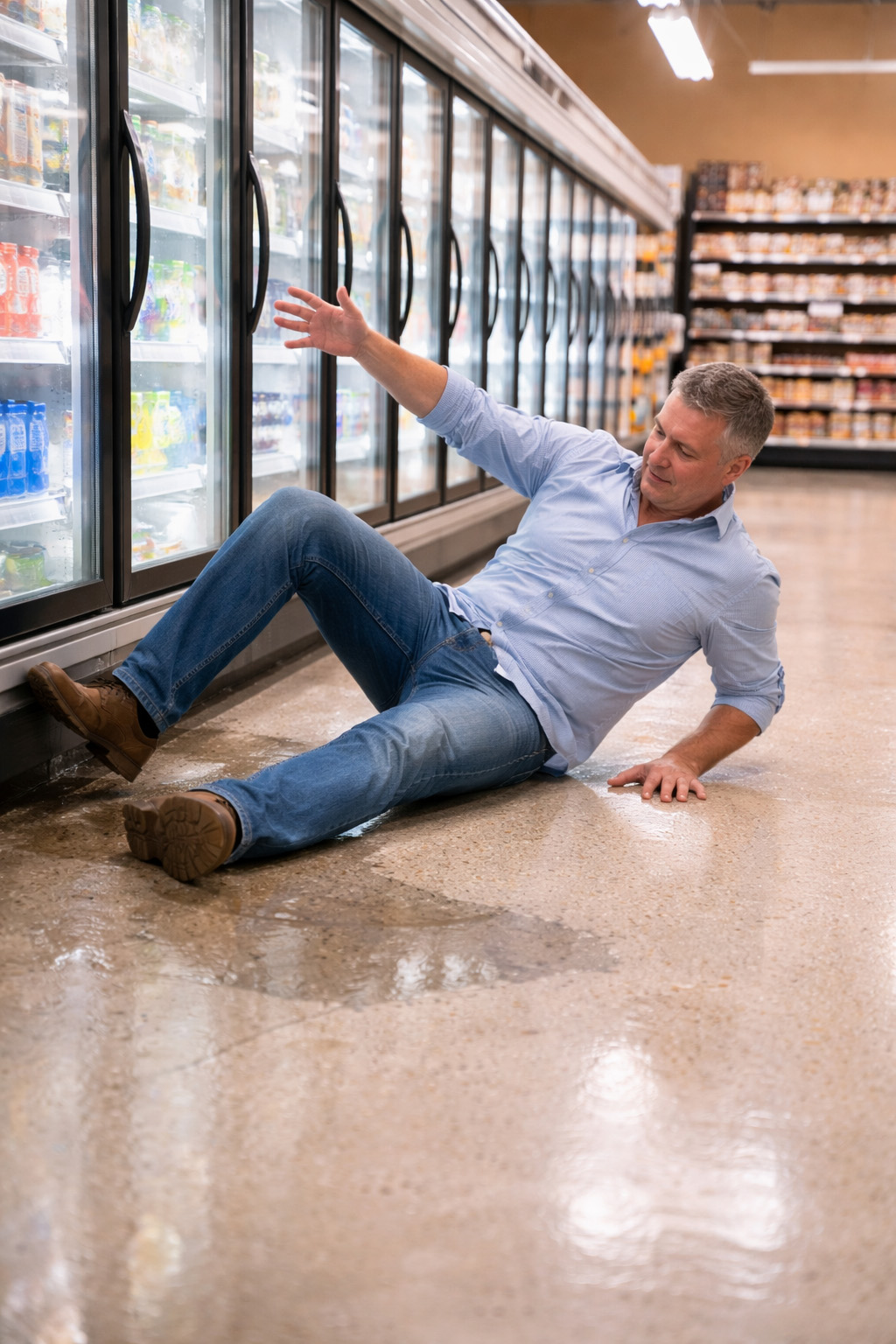 ry store slip and fall accident is a type of premises liability claim that occurs when a customer is injured due to unsafe conditions inside a grocery store. These accidents commonly result from hazards such as spilled liquids, dropped food items, wet floors, or improperly maintained walking areas.
Grocery stores present a high risk for slip and fall accidents because of constant customer traffic and frequent handling of liquids and food products. Under Florida law, grocery store owners and operators may be held legally responsible if they knew or should have known about a dangerous condition and failed to correct it within a reasonable time.
Legal Rule Summary: Under Florida Statute §768.0755, a grocery store may be liable if it had actual or constructive knowledge of a dangerous condition and failed to correct it.
Example: A customer may slip on spilled milk in an aisle. If employees failed to clean it or warn customers, the store may be liable.
Key Takeaway: Grocery store liability depends heavily on how long a hazard existed and whether it was addressed.
If you were injured in a grocery store, call 954-951-0000 to discuss your legal options.
A grocery store slip and fall accident occurs when a hazardous condition such as a spill or wet floor causes a customer to fall and suffer injuries.
Legal Overview: Grocery Store Liability
Grocery stores are considered business establishments under Florida premises liability law.
They have a legal duty to inspect aisles, clean hazards, and warn customers of dangerous conditions.
Because grocery stores handle liquids, produce, and packaged goods, hazardous conditions can develop quickly.
Key Takeaway: Grocery stores must actively monitor conditions, not just respond after accidents occur.
Quick Facts About Grocery Store Slip and Fall Accidents
- Grocery stores are high-risk environments
- Spilled liquids are a leading cause
- Inspection frequency is critical
- Cleaning logs are key evidence
- Liability depends on knowledge of hazard
Grocery Store Slip and Fall Accidents and Premises Liability
Premises Liability: Legal responsibility for unsafe property conditions.
Duty of Care: Grocery stores must maintain safe walking surfaces.
Dangerous Condition: Includes spills, debris, and wet surfaces.
Negligence: Failure to inspect, clean, or warn customers.
Key Takeaway: Grocery store accidents are among the most common premises liability claims.
Common Causes of Grocery Store Slip and Fall Accidents
Grocery stores contain multiple hazard sources due to inventory handling and customer activity.
- Spilled liquids (milk, juice, water)
- Dropped food items
- Leaking refrigeration units
- Wet floors from cleaning
- Produce debris
- Broken containers
- Mopped floors without warning signs
Key Takeaway: Most grocery store accidents are preventable with proper inspection and maintenance.
Where Grocery Store Slip and Fall Accidents Occur
- Produce sections
- Beverage aisles
- Freezer sections
- Checkout areas
- Entrances during rain
- Parking lots
Key Takeaway: High-traffic areas present the greatest risk of accidents.
Grocery Store Liability Test (Florida)
- Duty of Care
- Dangerous Condition
- Knowledge
- Failure to Act
- Causation
- Damages
Key Takeaway: The key legal issue is whether the store knew or should have known about the hazard.
Evidence in Grocery Store Slip and Fall Cases
Evidence is used to prove that a dangerous condition existed and caused the injury.
- Surveillance footage
- Cleaning logs
- Incident reports
- Witness statements
- Inspection records
Key Takeaway: Timing of inspections and cleanup is critical in grocery store cases.
Compensation in Grocery Store Slip and Fall Cases
Economic damages:
- Medical bills
- Lost wages
- Rehabilitation costs
Non-economic damages:
- Pain and suffering
- Emotional distress
- Reduced quality of life
Key Takeaway: Compensation depends on injury severity and long-term impact.
How Long Do You Have to File a Grocery Store Slip and Fall Claim in Florida?
Statute: Florida Statute §95.11 establishes the time limit for filing a personal injury lawsuit.
Plain English: In most grocery store slip and fall cases, injured individuals generally have two years from the date of the accident to file a claim.
Example: If a customer slips in a grocery store aisle, they typically must file their lawsuit within two years or risk losing their right to recover compensation.
What To Do After a Grocery Store Slip and Fall Accident
- Report the accident to store management immediately
- Seek medical attention
- Photograph the hazard and surrounding area
- Obtain witness information
- Preserve clothing and evidence
- Consult a lawyer as soon as possible
Comparative Negligence in Florida Grocery Store Cases
Florida follows a comparative negligence system, meaning compensation may be reduced if the injured person is partially at fault.
Example: If a customer is found 20% responsible for not paying attention, their compensation may be reduced by 20%.
Insurance companies often use comparative fault arguments to reduce payouts in grocery store accident claims.
Visitor Status and Legal Duty
- Invitees: Customers owed the highest duty of care
- Licensees: Social guests owed moderate care
- Trespassers: Limited duty of care
Key Takeaway: Grocery store customers are classified as invitees and receive the highest level of legal protection.
Grocery Store Slip and Fall Liability Factors
|
Hazard |
Evidence |
Liability Indicator |
|---|---|---|
|
Spilled liquid |
Video footage |
Time hazard existed |
|
Leaking cooler |
Maintenance logs |
Failure to repair |
|
Produce debris |
Inspection records |
Lack of inspection |
Grocery Store Slip and Fall Locations
Slip and fall accidents frequently occur in the following grocery store chains:
- Walmart Slip and Fall Accidents
- Publix Slip and Fall Accidents
- Aldi Slip and Fall Accidents
- Whole Foods Slip and Fall Accidents
- Costco Slip and Fall Accidents
- Sam’s Club Slip and Fall Accidents
- Trader Joe's Slip and Fall Accidents
- Winn-Dixie Slip and Fall Accidents
Each grocery store presents unique hazards and operational practices that may contribute to slip and fall accidents.
Key Takeaway: These locations should be developed into individual cluster pages to build topical authority.
Why Grocery Store Slip and Fall Cases Are Complex
Slip and fall cases in grocery stores often involve complex legal and factual issues, particularly when determining how long a hazard existed before the accident.
Insurance companies frequently argue that the hazard was temporary or that the injured person was partially responsible for the fall.
Proving liability often requires detailed evidence such as surveillance footage, cleaning logs, and expert analysis.
How The Injury Firm Handles Grocery Store Slip and Fall Cases
- Initial consultation
- Investigation of the accident scene
- Collection of surveillance footage and records
- Medical evaluation and documentation
- Negotiation with insurance companies
- Litigation if necessary
Each step is designed to build a strong claim and maximize compensation for injured clients.
Handling a Grocery Store Slip and Fall Claim Alone vs Hiring a Lawyer
|
Issue |
Handling Alone |
Hiring a Lawyer |
|---|---|---|
|
Evidence |
Limited access |
Professional investigation |
|
Negotiation |
Low leverage |
Experienced negotiation |
|
Valuation |
Uncertain |
Accurate case valuation |
|
Court Process |
Difficult |
Handled by legal professionals |
Handling a claim alone can be challenging due to the complexity of proving liability and negotiating with insurance companies.
An experienced lawyer can help gather evidence, evaluate damages, and advocate effectively on your behalf.
Related Slip and Fall Topics
- Restaurant slip and fall accidents
- Retail store slip and fall claims
- Hotel slip and fall injuries
- Apartment complex liability
- Parking lot accidents
Frequently Asked Questions
Can you sue a grocery store for a slip and fall accident?
Yes, you may sue a grocery store if it failed to maintain safe conditions or correct hazards within a reasonable time. Liability depends on whether the store knew or should have known about the dangerous condition.
What is the most common cause of grocery store slip and fall accidents?
Spilled liquids, dropped food items, and wet floors are the most common causes of accidents in grocery stores.
How do you prove negligence in a grocery store case?
You must show that the store had actual or constructive knowledge of a hazard and failed to correct it or warn customers.
What evidence is important in grocery store cases?
Important evidence includes surveillance footage, cleaning logs, incident reports, and witness statements.
How long do you have to file a claim in Florida?
Generally, you have two years from the date of the accident under Florida Statute §95.11.
Get Help After a Grocery Store Slip and Fall Accident
If you were injured in a grocery store due to unsafe conditions, you may have legal rights.
Call 954-951-0000 to speak with a lawyer today.
Visit the contact page to request a consultation and learn more about your options.
CONTACT US NOW
FREE CONSULTATION


THE INJURY FIRM
1608 East Commercial Blvd.
Ft. Lauderdale, FL 33334
Phone (954) 951-0000
Fax: (954) 951-1000
Click Here To Send Email
WEST PALM BEACH
2536 Okeechobee Blvd.
West Palm Beach, FL 33409
ORLANDO
4495 S. Semoran Blvd.
Orlando, FL 32822
Phone (407) 444-0000
Fax: (407) 402-1111
Click Here To Send Email
Grocery Store Slip and Fall Accidents | Florida Premises Liability Lawyer
Grocery Store Slip and Fall Accidents
On This Page
- What Is a Grocery Store Slip and Fall Accident
- Common Causes
- Where These Accidents Occur
- Legal Liability
- Evidence in Grocery Store Cases
- Grocery Store Locations
- Frequently Asked Questions
What Is a Grocery Store Slip and Fall Accident?
A grocery store slip and fall accident is a type of premises liability claim that occurs when a customer is injured due to unsafe conditions inside a grocery store. These accidents commonly result from hazards such as spilled liquids, dropped food items, wet floors, or improperly maintained walking areas.
Grocery stores present a high risk for slip and fall accidents because of constant customer traffic and frequent handling of liquids and food products. Under Florida law, grocery store owners and operators may be held legally responsible if they knew or should have known about a dangerous condition and failed to correct it within a reasonable time.
Legal Rule Summary: Under Florida Statute §768.0755, a grocery store may be liable if it had actual or constructive knowledge of a dangerous condition and failed to correct it.
Example: A customer may slip on spilled milk in an aisle. If employees failed to clean it or warn customers, the store may be liable.
Key Takeaway: Grocery store liability depends heavily on how long a hazard existed and whether it was addressed.
If you were injured in a grocery store, call 954-951-0000 to discuss your legal options.
A grocery store slip and fall accident occurs when a hazardous condition such as a spill or wet floor causes a customer to fall and suffer injuries.
Legal Overview: Grocery Store Liability
Grocery stores are considered business establishments under Florida premises liability law.
They have a legal duty to inspect aisles, clean hazards, and warn customers of dangerous conditions.
Because grocery stores handle liquids, produce, and packaged goods, hazardous conditions can develop quickly.
Key Takeaway: Grocery stores must actively monitor conditions, not just respond after accidents occur.
Quick Facts About Grocery Store Slip and Fall Accidents
- Grocery stores are high-risk environments
- Spilled liquids are a leading cause
- Inspection frequency is critical
- Cleaning logs are key evidence
- Liability depends on knowledge of hazard
Grocery Store Slip and Fall Accidents and Premises Liability
Premises Liability: Legal responsibility for unsafe property conditions.
Duty of Care: Grocery stores must maintain safe walking surfaces.
Dangerous Condition: Includes spills, debris, and wet surfaces.
Negligence: Failure to inspect, clean, or warn customers.
Key Takeaway: Grocery store accidents are among the most common premises liability claims.
Common Causes of Grocery Store Slip and Fall Accidents
Grocery stores contain multiple hazard sources due to inventory handling and customer activity.
- Spilled liquids (milk, juice, water)
- Dropped food items
- Leaking refrigeration units
- Wet floors from cleaning
- Produce debris
- Broken containers
- Mopped floors without warning signs
Key Takeaway: Most grocery store accidents are preventable with proper inspection and maintenance.
Where Grocery Store Slip and Fall Accidents Occur
- Produce sections
- Beverage aisles
- Freezer sections
- Checkout areas
- Entrances during rain
- Parking lots
Key Takeaway: High-traffic areas present the greatest risk of accidents.
Grocery Store Liability Test (Florida)
- Duty of Care
- Dangerous Condition
- Knowledge
- Failure to Act
- Causation
- Damages
Key Takeaway: The key legal issue is whether the store knew or should have known about the hazard.
Evidence in Grocery Store Slip and Fall Cases
Evidence is used to prove that a dangerous condition existed and caused the injury.
- Surveillance footage
- Cleaning logs
- Incident reports
- Witness statements
- Inspection records
Key Takeaway: Timing of inspections and cleanup is critical in grocery store cases.
Compensation in Grocery Store Slip and Fall Cases
Economic damages:
- Medical bills
- Lost wages
- Rehabilitation costs
Non-economic damages:
- Pain and suffering
- Emotional distress
- Reduced quality of life
Key Takeaway: Compensation depends on injury severity and long-term impact.
How Long Do You Have to File a Grocery Store Slip and Fall Claim in Florida?
Statute: Florida Statute §95.11 establishes the time limit for filing a personal injury lawsuit.
Plain English: In most grocery store slip and fall cases, injured individuals generally have two years from the date of the accident to file a claim.
Example: If a customer slips in a grocery store aisle, they typically must file their lawsuit within two years or risk losing their right to recover compensation.
What To Do After a Grocery Store Slip and Fall Accident
- Report the accident to store management immediately
- Seek medical attention
- Photograph the hazard and surrounding area
- Obtain witness information
- Preserve clothing and evidence
- Consult a lawyer as soon as possible
Comparative Negligence in Florida Grocery Store Cases
Florida follows a comparative negligence system, meaning compensation may be reduced if the injured person is partially at fault.
Example: If a customer is found 20% responsible for not paying attention, their compensation may be reduced by 20%.
Insurance companies often use comparative fault arguments to reduce payouts in grocery store accident claims.
Visitor Status and Legal Duty
- Invitees: Customers owed the highest duty of care
- Licensees: Social guests owed moderate care
- Trespassers: Limited duty of care
Key Takeaway: Grocery store customers are classified as invitees and receive the highest level of legal protection.
Grocery Store Slip and Fall Liability Factors
|
Hazard |
Evidence |
Liability Indicator |
|---|---|---|
|
Spilled liquid |
Video footage |
Time hazard existed |
|
Leaking cooler |
Maintenance logs |
Failure to repair |
|
Produce debris |
Inspection records |
Lack of inspection |
Grocery Store Slip and Fall Locations
Slip and fall accidents frequently occur in the following grocery store chains:
- Walmart Slip and Fall Accidents
- Publix Slip and Fall Accidents
- Aldi Slip and Fall Accidents
- Whole Foods Slip and Fall Accidents
- Trader Joe’s Slip and Fall Accidents
- Costco Slip and Fall Accidents
- Sam’s Club Slip and Fall Accidents
- Trader Joe's Slip and Fall Accidents
- Winn-Dixie Slip and Fall Accidents
Each grocery store presents unique hazards and operational practices that may contribute to slip and fall accidents.
Key Takeaway: These locations should be developed into individual cluster pages to build topical authority.
Why Grocery Store Slip and Fall Cases Are Complex
Slip and fall cases in grocery stores often involve complex legal and factual issues, particularly when determining how long a hazard existed before the accident.
Insurance companies frequently argue that the hazard was temporary or that the injured person was partially responsible for the fall.
Proving liability often requires detailed evidence such as surveillance footage, cleaning logs, and expert analysis.
How The Injury Firm Handles Grocery Store Slip and Fall Cases
- Initial consultation
- Investigation of the accident scene
- Collection of surveillance footage and records
- Medical evaluation and documentation
- Negotiation with insurance companies
- Litigation if necessary
Each step is designed to build a strong claim and maximize compensation for injured clients.
Handling a Grocery Store Slip and Fall Claim Alone vs Hiring a Lawyer
|
Issue |
Handling Alone |
Hiring a Lawyer |
|---|---|---|
|
Evidence |
Limited access |
Professional investigation |
|
Negotiation |
Low leverage |
Experienced negotiation |
|
Valuation |
Uncertain |
Accurate case valuation |
|
Court Process |
Difficult |
Handled by legal professionals |
Handling a claim alone can be challenging due to the complexity of proving liability and negotiating with insurance companies.
An experienced lawyer can help gather evidence, evaluate damages, and advocate effectively on your behalf.
Related Slip and Fall Topics
- Restaurant slip and fall accidents
- Retail store slip and fall claims
- Hotel slip and fall injuries
- Apartment complex liability
- Parking lot accidents
Frequently Asked Questions
Can you sue a grocery store for a slip and fall accident?
Yes, you may sue a grocery store if it failed to maintain safe conditions or correct hazards within a reasonable time. Liability depends on whether the store knew or should have known about the dangerous condition.
What is the most common cause of grocery store slip and fall accidents?
Spilled liquids, dropped food items, and wet floors are the most common causes of accidents in grocery stores.
How do you prove negligence in a grocery store case?
You must show that the store had actual or constructive knowledge of a hazard and failed to correct it or warn customers.
What evidence is important in grocery store cases?
Important evidence includes surveillance footage, cleaning logs, incident reports, and witness statements.
How long do you have to file a claim in Florida?
Generally, you have two years from the date of the accident under Florida Statute §95.11.
Get Help After a Grocery Store Slip and Fall Accident
If you were injured in a grocery store due to unsafe conditions, you may have legal rights.
Call 954-951-0000 to speak with a lawyer today.
Visit the contact page to request a consultation and learn more about your options.
CONTACT US NOW
FREE CONSULTATION